
Laser root canal
Laser-assisted root canal treatment
A root canal fails when bacteria survive in the parts of the tooth files cannot reach. Laser-assisted disinfection is how we reach them. Same comfort, same appointment, more thorough clean.
Why root canals fail
A root canal saves a tooth by removing the infected nerve tissue inside it, disinfecting the empty space, and sealing it so bacteria cannot return. When it works, and it usually does, the tooth can last a lifetime. When it fails, the reason is almost always the same: bacteria survived somewhere inside the root.
The root canal system is not a single straight tube. Under a microscope it looks more like a river delta. The main canal branches into side channels, fins, loops, and tiny accessory canals, particularly near the tip of the root. Files can clean the main canal. Syringe irrigation can flush what the files touch. Neither can reliably reach the branches, and the bacteria living there are protected by a sticky biofilm that resists the disinfecting solution. Months or years later, those survivors multiply, the infection returns, and the tooth needs retreatment, surgery, or extraction.
That is the problem laser-assisted disinfection was developed to solve. For a full overview of the procedure itself, start with our root canals page. This page covers the laser step specifically.
How laser-assisted disinfection works
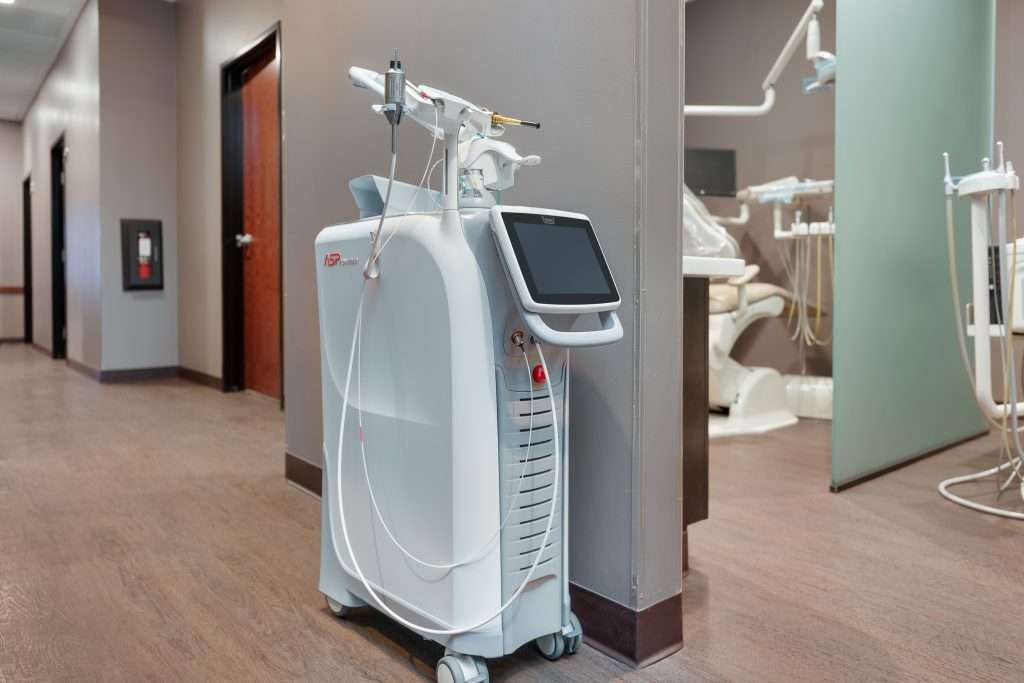
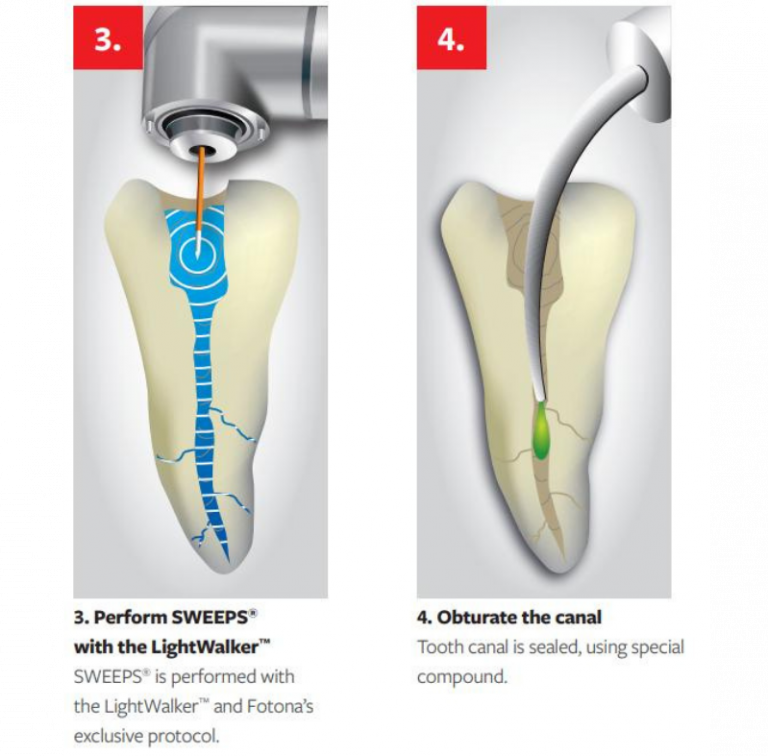
We use the Fotona LightWalker, an erbium laser, with two related protocols: PIPS, which stands for Photon Induced Photoacoustic Streaming, and its newer refinement SWEEPS, Shock Wave Enhanced Emission Photoacoustic Streaming. The physics are simple even if the names are not.
- After the canals are cleaned and shaped conventionally, the tooth is filled with the standard disinfecting solution.
- A thin laser fiber is placed in the solution in the pulp chamber. It does not go down into the canals and it does not touch the tooth.
- The laser fires extremely short pulses of energy into the liquid. Each pulse forms and collapses a tiny vapor bubble, which sends a pressure wave through the fluid.
- Those pressure waves stream the solution through the entire canal system, into the side branches and around the curves, breaking up biofilm and flushing out debris that files never touched.
- SWEEPS times the pulses so that the collapse of one bubble amplifies the next, producing stronger shock waves at lower energy, which improves cleaning while keeping the process gentle on the tooth.
The result is a canal system that has been cleaned three dimensionally rather than just along the path of the file. Laboratory and clinical studies consistently show significantly better removal of debris and bacteria compared with syringe irrigation alone, with the biggest difference in the areas that matter most, the lateral canals and the last few millimeters of the root.
Laser vs conventional root canal
It helps to be clear about what the laser changes and what it does not.
- Same diagnosis, same numbing, same access. The laser step comes after the canals are located and shaped. Everything before it is identical.
- Different disinfection. Conventional irrigation relies on a syringe and a needle placed partway down the canal. Laser activation moves the same solution through the whole system with pressure waves.
- Lower fluid pressure. Because the solution is streamed rather than pushed, there is less risk of forcing irrigant past the root tip, which is one cause of post operative soreness.
- More conservative shaping. Because the laser cleans where files cannot go, the canals do not need to be enlarged as aggressively, which preserves more of the root and makes the tooth less likely to fracture later.
- Same sealing, same crown. After disinfection the canals are sealed with gutta percha exactly as usual, and back teeth still need a crown to protect them.
A straightforward front tooth with a single wide canal does well with conventional treatment, and we do not add the laser just because it is in the room. A lower molar with four curved canals, a tooth that has already failed once, or an abscess that keeps coming back is where the laser earns its place.
Who benefits most
- Molars and premolars with complex anatomy, where multiple curved or narrow canals are the norm
- Retreatment cases, where a previous root canal has become reinfected and the bacteria have already survived conventional cleaning once
- Persistent infections and abscesses that have not responded to antibiotics or an initial cleaning
- Calcified canals in older teeth that files cannot fully navigate
- Teeth with open or immature root tips, where aggressive syringe irrigation carries more risk
- Patients who want the highest probability of saving the tooth on the first attempt rather than gambling on a retreatment
Root canal treatment at Sacramento Dentistry Group is led by Dr. Marjoorie Castro, our practice director, whose advanced endodontic training and years of teaching endodontics inform when we recommend laser activation and when conventional treatment is enough. She is known to say root canals are her favorite procedure, and it shows.
What the appointment looks like
- Diagnosis. X-rays, pulp testing, and 3D cone beam imaging when the anatomy is complex or a previous root canal is being evaluated.
- Numbing and isolation. Local anesthetic given time to work fully. A rubber dam keeps the tooth dry and protects you from the solutions used inside it.
- Access and shaping. The infected tissue is removed and the canals are located and shaped with fine instruments.
- Laser-assisted disinfection. The canals are flooded with disinfecting solution and the laser is activated in several short cycles. You will hear a rapid clicking or popping sound. You will not feel anything.
- Sealing. The clean, dry canals are filled and sealed. The access is closed with a filling.
- Restoration. A crown is scheduled for back teeth, usually one to two weeks later.
Most laser-assisted root canals are completed in a single visit of 60 to 90 minutes. Retreatments and severe infections occasionally need two visits with medication placed inside the tooth between them.
Safety and comfort
The Fotona LightWalker is FDA cleared for endodontic use and the PIPS and SWEEPS protocols follow the manufacturer's published settings, which use very low energy delivered in pulses measured in microseconds. The fiber never contacts the tooth, so there is no heating of the root and no removal of tooth structure. Everyone in the room wears wavelength specific protective eyewear. Post operative comfort is at least as good as conventional treatment, and many patients report less soreness because irrigant is not forced past the root tip. Anxious patients can combine treatment with oral conscious sedation.
Cost and insurance
The cost of a root canal depends on which tooth is being treated, since front teeth have one canal and molars have three or four. Dental insurance typically covers root canal treatment at 50% to 80% after the deductible. Laser-assisted disinfection may be built into the root canal fee or billed as a separate adjunctive step depending on the case, and we tell you which before treatment begins. A laser-assisted root canal and crown remains far less expensive than losing the tooth and replacing it with an implant. See accepted insurance plans, explore financing, or request an appointment online.
FAQ
Frequently asked questions
Common questions about laser-assisted root canal treatment.
What is a laser root canal?
A laser root canal is a conventional root canal with one important upgrade. After the infected pulp is removed and the canals are shaped, a laser fiber is placed in the disinfecting solution inside the tooth and fired in very short pulses. Those pulses create pressure waves that push the solution into the fine side branches, curves, and dead ends of the root canal system where bacteria hide and where files and syringes cannot reach. The technique is called PIPS or SWEEPS, and we perform it with the Fotona LightWalker laser.
Is a laser root canal more painful?
No. The laser fiber sits in liquid inside the tooth and never touches tooth structure. You are fully numb for the procedure exactly as you would be for a conventional root canal. Most patients report that the visit felt no different, and many describe less pressure than they expected because the technique uses lower fluid pressure than syringe irrigation.
Does laser disinfection make root canals more successful?
Published studies show that laser-activated irrigation removes significantly more debris and bacteria from the canal system than conventional syringe irrigation alone, particularly in the lateral canals and the apical third of the root where failures typically start. That is why we use it in cases with complex anatomy or persistent infection. Conventional root canals still have a high success rate for straightforward teeth, and we say so honestly rather than selling the laser as a cure-all.
Can a laser save a tooth that already had a failed root canal?
Often, yes. A previously treated tooth that has become reinfected is one of the strongest indications for laser-assisted disinfection, because the bacteria have already proven they can survive conventional cleaning. Retreatment involves removing the old filling material, cleaning and disinfecting the canals with the laser, and sealing the tooth again. When retreatment is not possible, the alternatives are surgery at the root tip or extraction with an implant.
Does it take longer?
Laser disinfection adds a few minutes to the cleaning phase of the root canal. Most laser-assisted root canals are still completed in a single 60 to 90 minute visit. The time saved by fewer retreatments and follow-up visits usually outweighs the few extra minutes in the chair.
Does insurance cover a laser root canal?
Dental insurance covers the root canal itself according to your plan, typically at 50% to 80% after the deductible. The laser disinfection step may be included in the root canal fee or billed as a separate adjunctive service depending on the case. We explain exactly how your treatment will be billed and what your estimated out of pocket cost is before we begin.
Get started
Tooth pain that keeps coming back?
If a tooth has been treated before and is hurting again, or the infection will not clear, laser-assisted disinfection may be the difference between saving it and losing it. Same day appointments are usually available.