
Wisdom teeth
Wisdom teeth removal
Impacted, partially erupted, or simply out of room. We remove most wisdom teeth in our own office with 3D imaging, sedation options, and a recovery plan you can actually follow.
Why wisdom teeth cause problems
Wisdom teeth are the third molars, the last teeth to develop and the last to come in, usually between the ages of 17 and 25. For most of human history they had a job and a place. Modern jaws are smaller than the jaws they evolved for, and in a large share of adults there simply is not enough room at the back of the mouth for a third molar to erupt straight and fully. When a tooth cannot come in properly, it does one of several things: it stays trapped in the bone, it comes in partway and stops, it tilts sideways into the tooth in front of it, or it erupts but so far back that it cannot be cleaned.
Each of those outcomes creates a specific problem. A partially erupted tooth leaves a flap of gum over it that traps food and bacteria, which leads to a painful, recurring infection called pericoronitis. A tooth tilted into its neighbor creates a pocket where decay attacks the second molar from the side, a tooth you actually need. A fully buried tooth can develop a cyst in the sac of tissue around it that slowly hollows out the jaw. And a tooth that is technically erupted but sits behind the reach of a toothbrush decays and causes gum disease at the back of the mouth.
Signs your wisdom teeth need attention
- Pain or pressure at the back of the jaw, especially when it comes and goes over weeks or months
- Swollen, tender, or bleeding gum tissue behind the last molar
- A bad taste or odor from the back of the mouth that brushing does not fix
- Difficulty opening your mouth fully or pain when chewing on that side
- Jaw stiffness, earache, or headache on one side
- Swelling in the cheek or the lymph nodes under the jaw
- Food constantly packing behind the second molar
Pain and swelling at the back of the mouth that come with fever, difficulty swallowing, or swelling that is spreading toward the neck are an emergency. Call our emergency line the same day.
Remove or keep? How we decide
Not every wisdom tooth needs to be removed, and we do not recommend surgery to people who do not need it. A wisdom tooth that has fully erupted into a normal position, has healthy gum around it, is not decayed, is not harming the tooth in front of it, and can be cleaned with a normal toothbrush is a tooth we monitor rather than remove. We take a panoramic X-ray at intervals and watch for change.
We recommend removal when a wisdom tooth is:
- Impacted in the bone or under the gum with no realistic path to erupt
- Partially erupted and causing repeated gum infections
- Decayed, or causing decay or bone loss on the second molar
- Associated with a cyst or other change in the surrounding bone on X-ray
- Interfering with planned orthodontic, implant, or denture treatment
- Impossible to clean, with gum disease already developing around it
One common myth is worth addressing directly. Wisdom teeth are often blamed for pushing the front teeth out of alignment after braces. The evidence for that is weak. Front teeth shift over time for many reasons, and the way to prevent it is wearing your retainer, not removing wisdom teeth that are otherwise healthy.
When removal is the right call, timing matters. In the late teens and early twenties the roots are still forming, the bone is more forgiving, and healing is faster. The same tooth removed at 45 is a bigger procedure with a longer recovery. That is why we review wisdom teeth at routine visits starting in the mid teens and give families a clear recommendation before problems start.
Impacted wisdom teeth
An impacted tooth is one that cannot fully erupt because it is blocked by bone, gum tissue, or another tooth. Impactions are described by how deep the tooth is and which direction it points:
- Soft tissue impaction. The tooth has come through the bone but is still covered by gum. Usually the simplest to remove.
- Partial bony impaction. Part of the tooth is still in the jawbone. A small amount of bone is removed to free it.
- Full bony impaction. The tooth is entirely within the bone. More bone removal and often sectioning the tooth into pieces.
- Angulation. A tooth may be vertical, tilted forward into the second molar (the most common), tilted backward, or lying fully horizontal. The angle affects how the tooth is sectioned and removed.
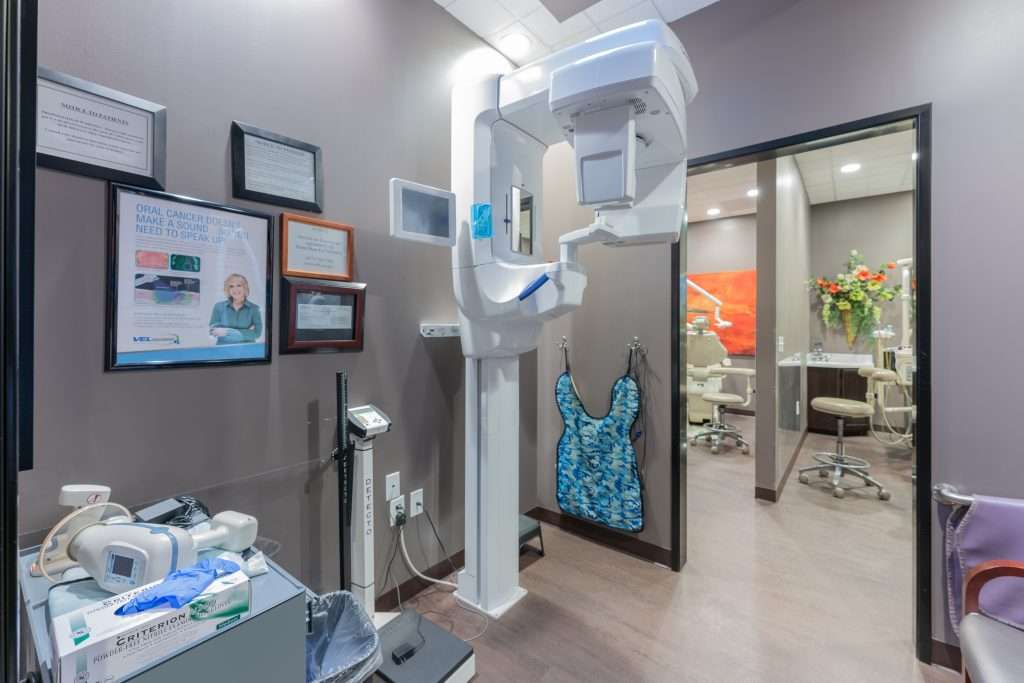
The single most important factor in planning a lower wisdom tooth removal is its relationship to the inferior alveolar nerve, which runs through the lower jaw and supplies feeling to the lip and chin. A panoramic X-ray gives a two dimensional picture. Our in office 3D cone beam scanner shows exactly where the roots sit relative to the nerve, which is how we decide what is safe to remove in house and which rare cases belong with an oral surgeon.
What the visit looks like
- Consultation and imaging. Panoramic X-ray, 3D scan if the roots are near the nerve, review of your medical history and medications. We explain what we see and what we recommend, tooth by tooth.
- Scheduling. Simple removals can sometimes be done the same day. Surgical removals and sedation cases are scheduled so you have a driver and a clear day or two afterward.
- Anesthesia. Topical gel, then local anesthetic given slowly and allowed to work fully. Oral conscious sedation if you chose it.
- Removal. For an erupted tooth, the tooth is loosened and lifted. For an impacted tooth, a small opening is made in the gum, a small amount of bone is removed if needed, and the tooth is often divided into sections so each piece comes out with minimal force.
- Closing the site. The socket is cleaned, dissolvable stitches are placed if needed, and gauze is positioned to help a clot form.
- Going home. Written aftercare instructions, any prescriptions, and a direct number to call with questions. We check on you the next day.
Removing all four wisdom teeth in one visit is common and is usually preferred, since it means one recovery instead of two.
Comfort and sedation
Many patients choose to have wisdom teeth removed with local anesthetic alone, and for a straightforward erupted tooth that is entirely reasonable. For impacted teeth, multiple teeth, or for patients who are anxious, we offer oral conscious sedation. You take a prescribed medication before the appointment, arrive relaxed, remain responsive throughout, and remember very little afterward. You will need someone to drive you home. Cases that require general anesthesia are referred to an oral surgeon, and we coordinate that referral for you.
Recovery, day by day
Recovery from wisdom tooth removal is predictable when the instructions are followed. Here is what to expect:
- Day of surgery. Bite on gauze for the first hour. Rest with your head elevated. Ice the cheek 20 minutes on, 20 minutes off. Start pain medication before the numbness wears off. Cold, soft foods only. No straws, no smoking, no spitting, no rinsing.
- Days 1 to 2. Swelling and stiffness increase and peak around day two or three. Continue ice on day one, then switch to warm compresses. Begin gentle salt water rinses after the first 24 hours. Soft foods: yogurt, eggs, smoothies eaten with a spoon, mashed potatoes, soup that is not hot.
- Days 3 to 5. Swelling starts to go down. Pain should be steadily improving. If it is getting worse, call us. Most patients return to school or desk work in this window.
- Week 2. Stitches dissolve. You can return to a normal diet and most exercise. Keep the sockets clean by rinsing gently after meals.
- Weeks 3 to 6. The gum has closed. The bone underneath keeps filling in for several months, and the small dimple where the tooth was gradually disappears.
The complete guide is on our extraction post op instructions page. Call us right away for bleeding that will not stop with pressure, fever, swelling that is spreading, numbness in the lip or chin that persists past the anesthetic, or pain that gets worse after day three.
Cost and insurance
The cost of wisdom teeth removal depends on how many teeth are removed, whether each is erupted or impacted, and whether you choose sedation. Most dental PPO plans cover wisdom tooth extraction at 50% to 80% after the deductible, with surgical and impacted removals sometimes coded differently than simple ones. Certain medical plans also cover impacted wisdom teeth. We verify your benefits before the appointment, file the claim directly, and provide a written estimate per tooth so you know the number before anything is scheduled. See accepted insurance plans, explore financing, or request a wisdom teeth consultation.
FAQ
Frequently asked questions
Common questions about wisdom teeth and their removal.
Do all wisdom teeth need to be removed?
No. If a wisdom tooth has fully erupted, is healthy, is not damaging the tooth in front of it, and you can keep it clean, leaving it in place and monitoring it with periodic X-rays is a reasonable plan. Removal is recommended when the tooth is impacted, partially erupted with recurring gum infection, decayed, causing decay or bone loss on the second molar, associated with a cyst, or interfering with planned orthodontic or restorative treatment.
What is the best age to have wisdom teeth removed?
When removal is needed, the late teens to mid twenties is the easiest window. The roots are not fully formed, the bone is softer, and healing is faster. Removal later in life is still routine, but the roots are longer, the bone is denser, and recovery tends to take a little longer. That is why we evaluate wisdom teeth on the panoramic X-ray at routine visits starting in the mid teens.
Do you remove impacted wisdom teeth in your office or refer out?
We remove the majority of wisdom teeth in our office, including many soft tissue and partial bony impactions, under local anesthetic with oral conscious sedation available. Teeth that are deeply impacted, wrapped around the nerve on 3D imaging, or that require general anesthesia are referred to a trusted oral surgeon. We tell you which category your teeth are in before anything is scheduled.
Does wisdom tooth removal hurt?
The procedure itself should not. You are fully numb, and sedation is available if you are anxious or want to remember as little as possible. You will feel pressure, not pain. Afterward, expect soreness and some swelling for two to four days, usually well controlled with ibuprofen and acetaminophen taken on a schedule.
How long does recovery take?
Most patients are back to school or desk work in two to three days and feel close to normal in about a week. Swelling peaks around day two or three and then improves. The gum closes over in two to three weeks. If pain gets worse rather than better after day three, call us, since that can be a sign of dry socket, which we can treat quickly.
What is a dry socket and how do I avoid it?
A dry socket happens when the blood clot that forms in the extraction site is dislodged or dissolves before the bone underneath has started to heal. It causes a deep, throbbing ache a few days after surgery. The main risk factors are smoking or vaping, drinking through a straw, spitting or rinsing forcefully, and birth control pills. Avoiding suction and tobacco for at least 72 hours prevents most cases. If you get one, we place a medicated dressing that relieves the pain within minutes.
Does dental insurance cover wisdom teeth removal?
Most dental PPO plans cover wisdom tooth extraction, typically at 50% to 80% after the deductible depending on whether the extraction is simple or surgical. Some medical plans also cover impacted wisdom teeth. We verify your benefits, file the claim, and give you a written estimate before your appointment. Financing is available for balances after insurance.
Get started
Wisdom teeth bothering you?
A consultation with a panoramic X-ray tells you which teeth need to come out, which can stay, and what it will cost. Same week appointments are usually available.